7 Tips for Choosing the Best Trailer Generator
Choosing the right Trailer Generator is more than comparing wattage and purchase prices. A reliable unit must match your trailer’s equipment, travel schedule, site conditions, and maintenance capacity. One generator may power lighting and small tools comfortably, yet struggle when compressors, pumps, or air conditioners start together. That starting surge is easy to overlook.
“Select the generator for real operating conditions, not the ideal number on the nameplate,” says Daniel Mercer, a mobile-power equipment consultant with over 20 years of field experience. His advice is practical. A dusty construction site, a cold morning, or a long tow can expose weaknesses that showroom testing misses. The best choice should feel stable on the road and dependable after hours of continuous operation.
This guide examines seven useful tips for choosing a Trailer Generator. It considers power output, starting capacity, fuel efficiency, noise control, trailer balance, weather protection, and service access. It also looks at safety features, including overload protection, grounding provisions, and clear emergency shutoffs. Small details matter. A poorly positioned fuel tank can make refueling awkward. Limited access panels can turn a simple filter change into an afternoon task.
There is no perfect model for every trailer. That is worth admitting. Buyers sometimes focus too heavily on maximum output and ignore transport weight. Others choose a quiet generator but underestimate fuel demand. Careful selection requires honest load calculations, realistic usage assumptions, and a little humility. The following tips can help you avoid expensive surprises and choose equipment that performs reliably in everyday conditions.
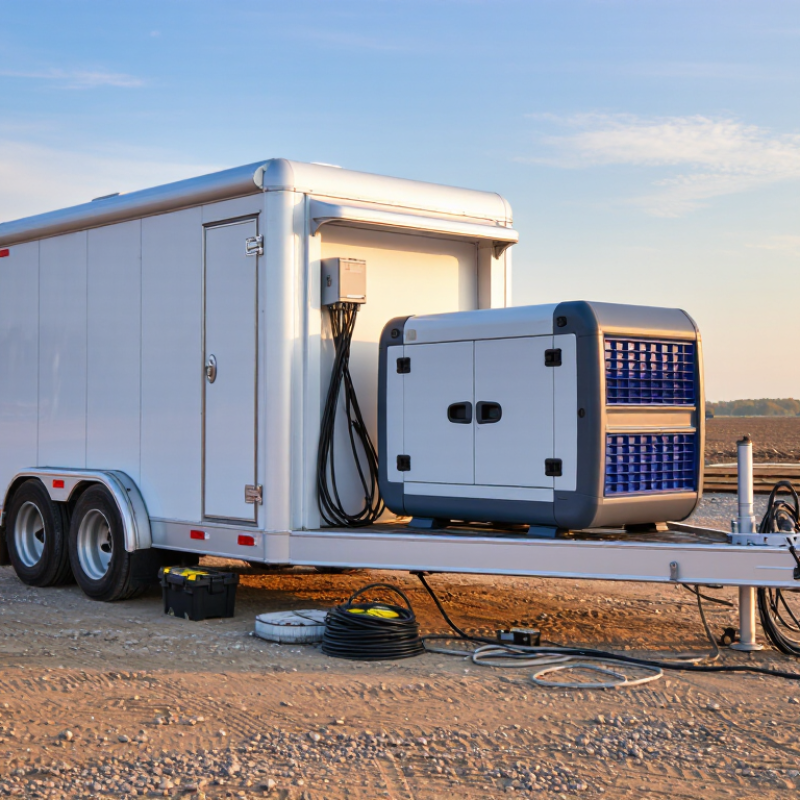
Calculate Total Demand: Add Starting Surge and Keep a 20% Capacity Reserve
Choosing the best trailer generator starts with an honest power calculation. List every device you may operate, including lights, chargers, pumps, tools, and climate equipment. Record each unit’s running wattage and starting surge.
Tip: Add running watts together, then identify the highest starting surge. A motor may briefly demand two or three times its normal power. For example, a 1,200-watt pump could require 3,000 watts during startup. The generator must handle that peak without stalling or dropping voltage.
Tip: Do not size the generator exactly to your calculated total. Add a 20% capacity reserve for safer operation and future equipment. If your running load is 4,000 watts and the largest startup demand adds 1,800 watts, your working requirement may reach 5,800 watts. With reserve, look for at least 6,960 watts of usable capacity.
Check the generator’s rated output, not only its maximum output. Rated power reflects sustained performance during real trailer work. I have seen estimates fail because refrigerator startup was ignored. It is an easy mistake. Recheck the figures when equipment changes, especially after adding a heater, compressor, or battery charger. Leave some headroom; crowded calculations often look precise but remain uncertain.
Compare Runtime: Measure Fuel Use and Operating Hours at 50% Load
Choosing the best trailer generator requires more than comparing tank size. Measure fuel use and operating hours at 50% load, where many portable units perform efficiently. The U.S. Energy Information Administration reports that diesel contains roughly 137,000 Btu per gallon. However, usable runtime depends on engine efficiency, alternator losses, temperature, and maintenance condition. Big tanks can create a misleading impression.
Ask suppliers for fuel consumption in gallons per hour at 50% load. Then divide usable tank capacity by that figure. For example, a 20-gallon tank using 0.8 gallons per hour should run about 25 hours. Real results may be lower. Leave a safety margin for cold starts, cable losses, and changing site demand. A field log is more valuable than a glossy specification sheet.
The ISO 8528 series encourages standardized generator performance testing, but test conditions still matter. Confirm whether the published figure reflects prime power, standby power, or a laboratory test. Record the load shown by the control panel, refueling volume, and shutdown time during a practical trial. Small errors accumulate. I have seen operators compare “runtime” figures measured at different loads, producing an unfair result. Compare like with like, preferably at 50%, then check performance at 25% and 75% loads. Fuel stability matters more than a headline number.
7 Tips for Choosing the Best Trailer Generator
Compare Runtime: Fuel Use and Operating Hours at 50% Load
This comparison uses representative diesel trailer-generator figures at 50% rated load. Fuel consumption is shown in liters per hour, while estimated runtime assumes a usable 100-liter fuel tank. Lower fuel use generally provides longer operating time between refueling.
Evaluate Noise and Emissions: Verify dB(A), EPA Tier, and CARB Standards
7 Tips for Choosing the Best Trailer Generator
Noise and emissions deserve more than a brochure check. Confirm the generator’s sound level in dB(A), including the test distance, operating load, and measurement conditions. NIOSH recommends limiting occupational noise to 85 dB(A) over eight hours. A unit rated at 70 dB(A) may still sound intrusive beside homes, schools, or night work areas. Field conditions change everything.
Tip: Ask for a full test report, not only a single dB(A) number. Check readings at idle and rated load. Listen near the exhaust, too. Vibration, hard surfaces, and nearby walls can increase perceived noise. I would not trust an unusually low rating without test details.
Emissions require equal scrutiny. The U.S. EPA reports that Tier 4 Final nonroad diesel standards can reduce particulate matter by about 50% and nitrogen oxides by up to 80% compared with earlier Tier levels. Verify the engine’s EPA Tier certification and its rated power range. For California projects, check CARB compliance, applicable Executive Orders, and registration requirements before delivery. CARB’s portable-engine rules may require documentation beyond a general “clean diesel” claim. A certificate, label, or serial-number record should match the actual engine. Small paperwork gaps can create large scheduling problems. EPA and CARB requirements also change by engine type, location, and use. Verify current rules with the agency.