
Cylinder Seal Kits may look like small components, but a poor seal can stop a large machine. In excavators, presses, and agricultural equipment, buyers need kits that match the cylinder’s dimensions, pressure, temperature, and fluid. China offers a broad supplier base, yet supplier claims are not equal to verified performance. Details matter.
Industry research helps frame the market, but it rarely provides a ready-made supplier ranking. Grand View Research’s published analysis of the hydraulic seals market examines demand by application and material, while other market studies track industrial sealing products across sectors. These reports indicate the wider commercial context; they do not independently certify individual Chinese manufacturers. Trade data also has limits: product categories may group seal kits with other rubber or hydraulic goods. That leaves a blind spot.
This guide looks at suppliers through practical evidence: manufacturing capability, material options, dimensional control, sample quality, documentation, and responsiveness to technical questions. Buyers should ask for drawings, compound specifications, batch traceability, and test results relevant to their operating conditions. A polished catalogue is not enough. Nor is a low quotation, especially when fit or service life remains untested. The comparisons that follow are intended as a starting point, not a substitute for qualification testing. Some supplier information can change quickly, and public evidence is uneven. That is worth keeping in mind.
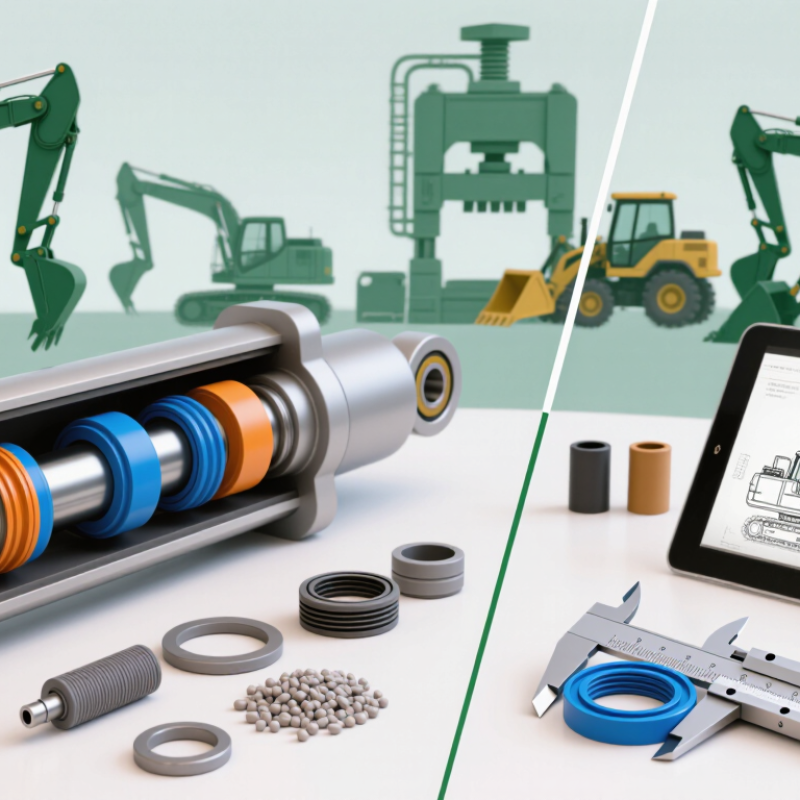
A cylinder seal kit contains replacement sealing parts for a hydraulic or pneumatic cylinder. Depending on the cylinder design, it may include a piston seal, rod seal, wiper, O-rings, and wear rings. Each part has a job: the rod seal limits fluid leakage, while the wiper helps keep dust and grit out. Small parts matter.
These kits are used in excavators, farm machinery, vehicle lifts, industrial presses, and factory equipment. A hydraulic cylinder may move a loader arm under heavy pressure; a pneumatic cylinder may position a component on a production line. In either case, seals help maintain pressure and controlled movement. Kit contents and materials vary, so check the cylinder bore, rod diameter, fluid type, and operating temperature before ordering. A near match may still fail.
During a rebuild, technicians typically inspect the rod and cylinder bore as well as replacing seals. A scratch you can feel with a fingernail can damage a new seal. Clean parts carefully, follow the cylinder’s service specifications, and use compatible assembly lubricant. The kit alone cannot fix a bent rod or a scored bore. That detail is easy to miss. A trained technician can help identify the underlying cause when leakage returns soon after repair.
China’s cylinder seal kit market is not one uniform supplier group. It includes seal manufacturers, hydraulic component makers, and sourcing companies that combine products from several factories. Some manufacturers produce sealing elements in-house; others assemble kits using purchased seals, backup rings, and O-rings. That distinction can affect traceability, customization, and lead time. A kit for a compact excavator may contain rod seals, a dust wiper, a piston seal, and static rings matched to specific grooves. Not all are equal.
Suppliers serve different purchasing needs. Larger production sites may handle repeat orders and broad size ranges, while smaller specialists can be more responsive to unusual dimensions. Trading companies may simplify communication and consolidate shipments, but ask who selects materials and checks finished kits. Request drawings, compound information, tolerances, and samples. Test samples against operating temperature, pressure, speed, and hydraulic fluid. A neatly packed kit can still fail after installation. I would not treat a broad catalog as proof of deep technical support; specifications can be surprisingly thin.
Tips: Share the cylinder model, measurements, and working conditions together. Ask for clear labeling on each seal and ring. Confirm whether the kit is made in-house or assembled from sourced parts. Keep a sample for comparison. Small mismatch, big leak.
China’s cylinder seal kit market is served by several supplier types, each with a different strength. Integrated manufacturers make seals and assemble kits in-house. They may offer more control over material selection, dimensions, and production checks. Ask how they verify fit, not only how many kits they list. Small details matter.
Specialist seal producers focus on materials and sealing profiles, such as polyurethane or nitrile components for particular operating conditions. Their technical teams may help match a kit to cylinder drawings, pressure, and temperature. A sample set can reveal practical issues, including a seal that fits the groove but feels too tight during installation. That matters.
Hydraulic parts distributors and export-focused suppliers also play a visible role. They often combine kits from multiple sources and can help buyers compare availability or handle mixed orders. However, the source of each component may not be obvious. Request clear kit contents, material specifications, inspection records, and batch traceability. A polished catalog is not proof of compatibility. Supplier categories can overlap, and I would not assume that a larger factory always delivers the best technical support. Check response quality with a real drawing or worn-seal sample before placing a substantial order.
Comparing cylinder seal kit suppliers starts with the standards behind their claims. ISO 9001 can indicate a documented quality management system, but it does not prove that every seal fits your cylinder. For O-rings, ask whether dimensions and tolerances are checked against ISO 3601. For piston and rod seals, confirm that the proposed housing dimensions suit the relevant application standards and your actual equipment.
Details matter. Request material data, batch traceability, and inspection records for the kit you plan to buy. A reliable supplier should explain how its elastomer or polyurethane performs with your hydraulic fluid, operating temperature, pressure, and expected movement. Ask for proof. Sample test reports and dimensional inspection results are more useful than broad claims about quality.
Compare how suppliers handle variation, too. Can they identify a batch, explain a failed inspection, and provide replacement parts with consistent dimensions? Clear packaging labels and protected seals matter; a nicked lip can cause trouble before installation. Certificates deserve scrutiny, not automatic trust. I would still verify a sample in the intended cylinder, because paperwork cannot reveal every mismatch. This step takes time, and small buyers may find it awkward, but it can expose fit problems early.
Standards and evidence can help buyers compare suppliers; this chart shows an illustrative evaluation framework, not a ranking or survey of companies.
How to use it: Apply the example 100-point weighting to each supplier using documented evidence. Check relevant requirements for the application, such as ISO 3601 for O-rings, ISO 6195 for rod wiper-ring housings, and ISO 7425-1/-2 for piston and rod seal housings. Confirm the applicable edition and scope; these standards do not by themselves certify a supplier.
When comparing cylinder seal kit suppliers in China, verify the products against your actual operating conditions. Send a drawing or a worn sample, then ask the supplier to confirm dimensions, seal profile, material, temperature range, and fluid compatibility in writing. A kit may look correct in a photo yet fail when its seal hardness or groove fit is wrong. Details matter.
Request inspection records for incoming materials and finished kits. Useful evidence can include material certificates, dimensional reports, and batch identification linking each kit to its production record. Ask how staff check molded seals for cuts, flash, or uneven edges, and how they protect parts from dust during packing. A polished brochure is not proof. Ask for a recent, anonymized report or a live video walkthrough of the inspection process.
Manufacturing capability needs separate verification. Ask which operations are performed in-house, what equipment is used, and which processes rely on outside partners. A factory visit, independent audit, or controlled sample order can help confirm the answers. Compare the sample with the approved drawing before discussing larger quantities. Keep a written record of revisions and acceptance criteria. I have seen procurement checks overlook packaging; it is an easy detail to miss, but mixed sizes or unclear labels can slow maintenance work. No single document proves everything. Use several checks, and note any gaps before approving a supplier.
A practical supplier-evaluation guide for hydraulic cylinder seal kits. Use verifiable documents and product tests rather than unsubstantiated rankings or sales claims.
| Evaluation Dimension | What a Capable Supplier Should Provide | How to Verify | Warning Signs |
|---|---|---|---|
| Product range and application fit | Seal kits identified by cylinder model, seal position, dimensions, material, and operating application. Common components may include piston seals, rod seals, wipers, guide rings, and O-rings. | Request a component list and dimensioned drawings. Compare each item with the cylinder drawing or the original part measurements before ordering. | Parts are described only as “universal,” with no dimensions, material details, or application information. |
| Material identification | Material grades and compound information appropriate to the intended fluid, temperature, pressure, and operating conditions. Material names should be specific rather than limited to generic labels. | Ask for material specifications, batch identification, and relevant test documentation. Confirm compatibility against the equipment and hydraulic-fluid requirements. | Material is identified only as “rubber” or “plastic,” or the supplier cannot link material records to a production batch. |
| Manufacturing capability | Documented production processes suited to the parts offered, such as molding or machining, with controlled inspection of dimensions and visible defects. | Request a live or recorded factory audit, process flow, equipment list, and sample inspection records. Confirm that the audited site is the site producing the goods. | Factory evidence is limited to showroom photos, or the supplier cannot explain which processes are performed in-house and which are outsourced. |
| Quality management | A defined quality system covering incoming materials, production checks, final inspection, nonconforming products, and corrective action. | If an ISO 9001 certificate is claimed, check its validity, scope, issuing certification body, and certified site. A certificate supports review of the quality system but does not by itself prove product performance. | Certificate details cannot be independently confirmed, or the certificate scope does not cover the relevant manufacturing activity or site. |
| Dimensional inspection | Inspection methods and records appropriate to the specified seal dimensions and tolerances, including checks on samples or production lots. | Ask for a recent dimensional inspection report tied to a sample or batch. Compare reported measurements and tolerances with the approved drawing. | Reports contain no part identification, measurement results, tolerances, or inspection date. |
| Product testing and traceability | Test records relevant to the product and application, plus a way to trace delivered items to production or material batches. | Ask what was tested, by which method, and on which sample or batch. For third-party reports, verify the laboratory and report details; ISO/IEC 17025 accreditation applies to a laboratory’s stated testing scope. | Generic test certificates are presented without sample identity, test method, results, or traceability to the offered products. |
| Sample and fit verification | Samples that match the proposed production specification and packaging, with clear part identification. | Test-fit a sample in the intended cylinder and inspect installation, dimensions, and sealing performance under an appropriate controlled procedure before approving bulk production. | The supplier refuses pre-production samples or changes material or dimensions without written approval. |
| Order control and consistency | Written specifications, approved sample references, change notification, and consistent part and batch identification across repeat orders. | Put drawings, material requirements, inspection criteria, packaging, and change-approval requirements into the purchase specification. Compare repeat-order samples with the approved reference. | Product specifications remain verbal, or substitutions are made without the buyer’s documented approval. |
| Export and business documentation | Clear quotations, commercial invoices, packing lists, agreed delivery terms, and product descriptions consistent with the order. | Check that the contracting, payment, and shipping details are consistent with the supplier’s verified business records and the agreed purchase documents. | Unexplained changes to beneficiary, contracting party, or product description occur during the transaction. |
| After-sales and claims handling | A documented process for handling fit, quality, or delivery claims, including the information required for investigation and corrective action. | Ask for the claim procedure, response contact, and examples of how defective batches are investigated and resolved. | There is no clear process for reporting issues, or the supplier will not define how claims and replacement decisions are handled. |
Selection principle: This is a verification framework, not a ranked list of named suppliers. Shortlist suppliers only after confirming product fit, manufacturing-site identity, traceable quality records, and acceptable sample results.