


When global buyers evaluate a Trash Cabinet, appearance is only part of the decision. A cabinet may look polished online, yet arrive with thin panels, weak hinges, or unclear assembly instructions. Practical buying experience shows that small details often create the largest costs. Measure the available space first. Then consider waste volume, cleaning routines, and local collection habits. A narrow cabinet can suit a city apartment. A larger commercial unit may need reinforced doors and adjustable shelves.
This guide presents ten buying tips for comparing products, suppliers, and total ownership value. It examines material quality, odor control, ventilation, capacity, safety, customization, packaging, lead times, and after-sales support. Buyers should request drawings, finish samples, test information, and recent production photographs. Supplier claims deserve verification. Check dimensions twice. A few millimeters can affect installation. Stainless steel, coated steel, wood-based panels, and recycled plastics perform differently in humid or high-traffic settings. The right choice depends on use, not fashion.
Global sourcing also requires clear communication. Confirm unit measurements, delivery terms, spare parts, warranty coverage, and inspection procedures before payment. Requirements vary by building type and market. Local waste-handling practices should guide the design. Do not assume the cheapest quotation offers the best value. Nor is the most expensive option automatically reliable. Some recommendations may need adjustment after real-world testing. That is worth admitting. A careful comparison reduces surprises and supports a cleaner, more efficient purchasing decision.
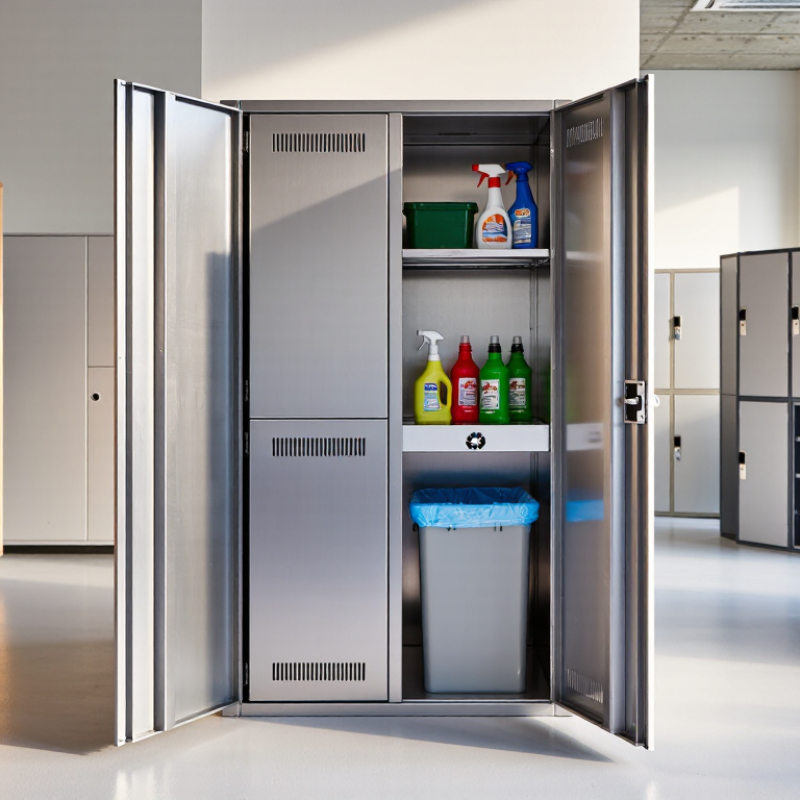
Choosing the right trash cabinet starts with understanding its type and location. Indoor pull-out cabinets suit kitchens with limited floor space. Freestanding units work better in utility rooms, offices, and rental properties. Wall-mounted designs keep bins away from wet floors. Outdoor cabinets need weather-resistant panels, sealed joints, and stable anchors.
Capacity should match local waste habits, not only the number of household members. A 30-liter cabinet may suit a small apartment, while a larger family may need separate compartments for general waste, food scraps, and recyclables. Check the opening size, liner compatibility, door clearance, and ventilation. Small details matter. A beautiful cabinet can fail if the bin cannot slide out fully.
Global buyers also need to review dimensions in metric units, installation instructions, packaging strength, and replacement-part access. Materials should tolerate the destination’s humidity, temperature changes, and cleaning products. Stainless steel handles moisture well, while coated wood-based panels need careful edge protection. Confirm product test reports and material declarations from the supplier. Requirements vary by market, so local waste rules and building conditions should be checked before purchase. In my experience, buyers often focus on appearance and underestimate shipping damage. I have also seen oversized cabinets create avoidable installation problems. Rechecking measurements feels slow, but it prevents expensive returns.
| No. | Buying Tip | Cabinet Type | Typical Specification | Global Buyer Requirement | Key Verification Point |
|---|---|---|---|---|---|
| 1 | Match the capacity to the waste volume | Single-bin cabinet | Common internal bin capacities include approximately 20–30 L for compact indoor use, 40–60 L for general household or office use, and 80–120 L for higher-traffic areas. | Select capacity according to local collection frequency, available floor space, and the expected volume of dry or mixed waste. | Confirm both the usable bin volume and the external cabinet dimensions. The advertised capacity may refer only to the removable liner or container. |
| 2 | Choose the correct waste-separation layout | Multi-compartment cabinet | Two- and three-compartment layouts are widely used for separating general waste, recyclables, paper, glass, or organic waste. | The compartment labels, colors, and icons should be adaptable to the destination market’s recycling system and language requirements. | Check whether each opening leads to a dedicated container and whether the internal partitions prevent cross-contamination during removal. |
| 3 | Compare indoor and outdoor construction | Indoor or outdoor cabinet | Indoor models commonly use powder-coated steel, stainless steel, wood-based panels, or plastic components. Outdoor models require weather-resistant finishes and corrosion-resistant hardware. | Outdoor installations may need resistance to rain, ultraviolet exposure, humidity, temperature changes, and wind. Indoor products should prioritize appearance and easy cleaning. | Request coating information, corrosion-test details where applicable, drainage provisions, and evidence that hinges and fasteners are suitable for the intended environment. |
| 4 | Evaluate fire-safety needs | Fire-resistant cabinet | Fire-resistant designs may include steel construction, self-closing doors, restricted openings, heat-resistant seals, and internal containers made from non-combustible materials. | Requirements vary by building type and jurisdiction. Offices, hotels, transport facilities, healthcare sites, and public buildings may impose additional fire-safety rules. | Do not treat a metal exterior alone as a fire rating. Request the applicable test report or certification and verify acceptance with the local authority or project consultant. |
| 5 | Check accessibility and operating height | Front-opening or top-opening cabinet | Front-opening doors support removable bins and easier servicing. Top openings are useful for high-traffic disposal points but should be positioned for comfortable reach. | Public and commercial projects may require accessible openings, clear approach space, readable symbols, and operating features usable by people with limited mobility. | Review the opening height, door force, handle design, clearance, and local accessibility rules before approving the final layout. |
| 6 | Prioritize hygiene and cleaning performance | Hygienic or sealed cabinet | Useful features include smooth non-porous surfaces, rounded corners, removable liners, concealed hinges, leak-resistant containers, and touch-free or foot-operated access. | Food-service, healthcare, hospitality, and humid environments generally require frequent cleaning and materials that tolerate approved detergents or disinfectants. | Ask for cleaning instructions, chemical-resistance information, replacement-seal details, and confirmation that liquid leakage will not damage the cabinet base. |
| 7 | Confirm material and corrosion protection | Steel or stainless-steel cabinet | Steel cabinets are often powder-coated for appearance and protection. Stainless-steel cabinets provide strong corrosion resistance when the correct grade and finish are selected. | Coastal, tropical, and industrial locations may require improved corrosion resistance, while indoor dry locations may permit more economical materials. | Verify sheet thickness, stainless-steel grade when specified, coating process, edge protection, weld quality, and compatibility with the destination climate. |
| 8 | Plan installation, mobility, and anchoring | Freestanding, wall-mounted, or mobile cabinet | Freestanding units offer flexible placement; wall-mounted units save floor space; mobile units may use casters for servicing but need stable brakes. | Global projects may involve different floor types, wall structures, seismic conditions, delivery routes, and installation practices. | Confirm the total loaded weight, fixing hardware, wall or floor load requirements, caster load rating, access for maintenance, and packaging protection during transport. |
| 9 | Review labels, colors, and language | Recycling or sorting station | Labels may use text, pictograms, color coding, or a combination. Clear icons are useful when several languages are used at one site. | Waste categories and color conventions differ by country and municipality. Local rules should take priority over a generic international color scheme. | Approve artwork, translations, icon meanings, label durability, printing method, and replacement options before mass production. |
| 10 | Calculate total landed cost and compliance | Project or custom cabinet | The purchase cost may include the cabinet, internal bins, labels, accessories, packaging, freight, import charges, installation, and future replacement parts. | Buyers should account for destination-country product rules, electrical requirements for sensor-equipped models, customs documentation, warranty terms, and after-sales support. | Request a complete specification sheet, packing dimensions, net and gross weight, harmonized tariff classification support, inspection documents, spare-parts list, and clearly defined warranty coverage. |