

Food processors need thermal systems that protect safety without sacrificing texture, throughput, or consistency. The FAO’s 2023 report, The State of Food and Agriculture, estimates that 13.2% of food is lost between harvest and retail worldwide. That figure does not show how much retort processing can save. It does underline why reliable preservation and careful process control matter.
A Cascade Retort circulates heated water over product loads during thermal processing. Depending on its design, the system can support even heat distribution across trays or baskets. This may help processors manage temperature variation and product quality across repeated batches. Yet results depend on the container, load pattern, recipe, and validated processing schedule. A few crowded trays can change heat transfer. Small details matter.
Food safety also depends on evidence, not equipment claims alone. The World Health Organization’s 2015 Estimates of the Global Burden of Foodborne Diseases reported about 600 million foodborne illness cases and 420,000 deaths annually. A retort cannot address every hazard, and no single machine guarantees safe food. Operators need validated processes, calibrated instruments, documented checks, and trained staff. This article examines why processors choose a Cascade Retort, what operational advantages it may offer, and which limitations deserve close review. The practical question is not simply whether it heats food, but whether it delivers consistent, verified results for a specific product and package. Not magic. Just process control.
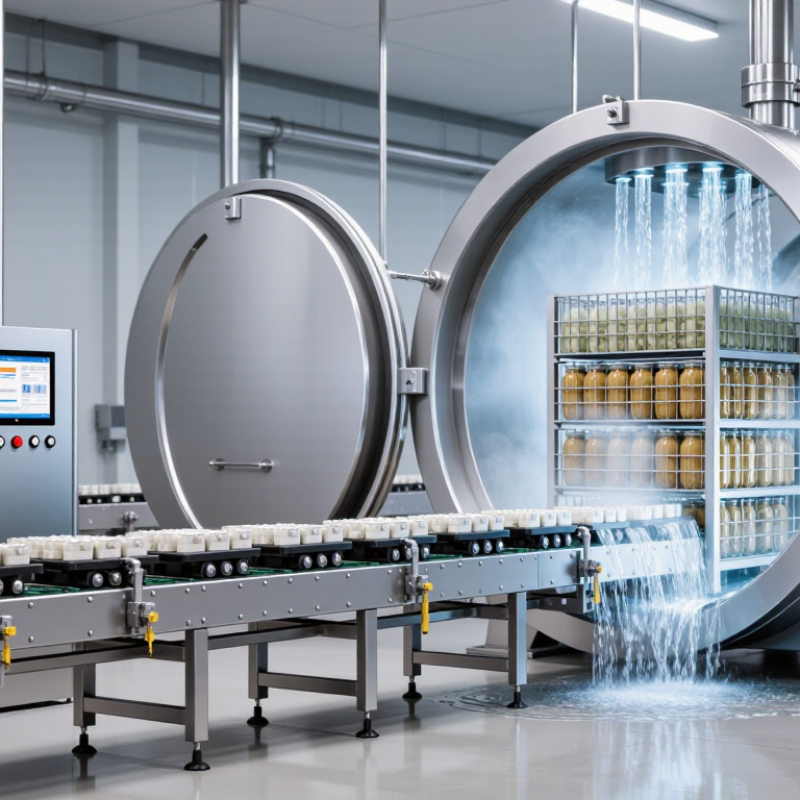
A cascade retort processes sealed food packages by circulating heated water through a pressure-controlled vessel. Baskets hold cans, jars, or suitable flexible packs in a defined loading pattern. A pump sends hot water across the load, creating a moving cascade that transfers heat to package surfaces. The water is recirculated, so temperature can be managed throughout the chamber. It is not simply a hot-water bath.
During the heating stage, operators follow a validated time-and-temperature schedule for the specific food, package, and load. Sensors track conditions, while pressure helps protect packages from damage as temperatures change. After processing, cooling water lowers the product temperature under controlled pressure. That matters. The product’s cold spot heats more slowly than its outer layers, so the schedule must account for it. A retort cannot compensate for poor loading or an unsuitable package.
Tips: Keep package spacing consistent and avoid blocking water flow. Check seals and record process data for each run. Small details count. Actual settings vary by product and equipment, so confirm them through qualified process review. Even a well-run cycle deserves a careful check.
| Process Dimension | What Happens in a Cascade Retort | Why It Matters for Packaged Foods | Key Control or Consideration |
|---|---|---|---|
| Loading and package preparation | Filled and sealed packages are loaded into baskets or carriers according to the validated loading pattern. | Consistent spacing and orientation help water circulate around packages and support repeatable heating. | Use the package type, load arrangement, and basket configuration specified for the scheduled process. |
| Water circulation | A pump circulates process water, which is distributed over the load in a cascading or showering pattern. | Moving water transfers heat to package surfaces and helps reduce temperature differences within the retort load. | Circulation performance and water distribution must be established and maintained for the retort and load. |
| Come-up and heating | The circulating water is heated, commonly through a heat exchanger, until the process reaches its specified conditions. | Controlled heating brings the product toward the temperature required by its validated thermal process. | Heating time and temperature depend on the product, container, fill, and process design; there is no single universal schedule. |
| Temperature holding | The retort maintains the scheduled process conditions for the required time after the process temperature is reached. | The holding phase delivers the thermal treatment needed for the intended food-safety objective and product stability. | Follow the established scheduled process and applicable food-processing regulations; do not substitute a generic time or temperature. |
| Pressure and package protection | Retort pressure may be controlled, including with compressed air in applicable systems, to balance pressure changes during heating and cooling. | Appropriate pressure control can help protect flexible and semi-rigid packages from distortion or seal damage. | Pressure settings and control methods are equipment- and package-specific and must match the validated process. |
| Cooling | After the heat treatment, the load is cooled using circulating water; pressure may be maintained as needed during cooling. | Cooling limits continued cooking and helps protect packages while their contents and headspace change temperature. | Cooling-water quality, cooling conditions, and pressure control should be managed under the facility’s validated procedures. |
| Suitable package formats | Cascade retorts can be designed for specified containers such as cans, glass jars, and flexible or semi-rigid packages. | Water-based heat transfer can be applied to a range of package formats when the system and process are designed for them. | Compatibility depends on the retort design, package construction, closure, loading arrangement, and process validation. |
| Process monitoring and records | Operating instruments and records track relevant process conditions, such as temperature, pressure, and cycle timing. | Reliable records support process verification, traceability, and review of deviations. | Instrumentation, calibration, recordkeeping, and corrective actions should meet applicable regulations and facility procedures. |
| Potential operational benefits | Recirculated water provides a controlled heat-transfer medium, and automated controls can manage repeatable process steps. | These features can support consistent processing across properly configured loads and help accommodate multiple package formats. | Actual performance, energy use, throughput, and product quality depend on equipment design, operating conditions, and the validated process. |