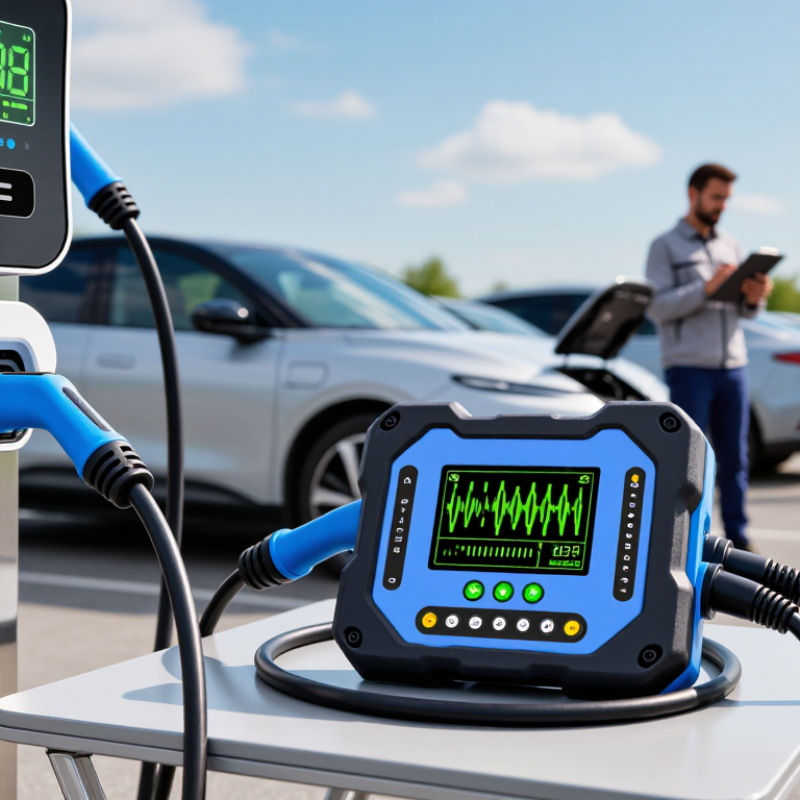
Why Do You Need an EV Charger Tester?

Electric vehicle charging depends on more than a plug and a power supply. The International Energy Agency’s Global EV Outlook 2024 reports nearly 14 million electric car sales in 2023, representing about 18% of global car sales. It also notes that public charging points grew by more than 40% that year. More chargers mean more equipment to inspect, commission, and maintain.

An Ev Charger Tester helps technicians check whether an electric vehicle supply equipment unit responds correctly before a vehicle relies on it. Depending on the model, it can simulate vehicle connection states and assess functions such as control-pilot signaling, protective-earth continuity, and charging status. A loose connection or incorrect pilot response may otherwise appear only when a driver plugs in. That is not a useful moment to discover a fault.

Testing matters. But a tester is not a magic guarantee. Its readings depend on correct setup, suitable test procedures, and equipment compatibility. IEC 61851 describes general requirements for conductive charging systems, while relevant product and installation requirements vary by region. Technicians should follow the applicable standards and manufacturer instructions, and use appropriate electrical safety practices. A tester can reveal problems; it cannot replace sound installation, inspection, or judgment. That limitation deserves attention.

Why Do You Need an EV Charger Tester?

What an EV Charger Tester Is and How It Works

Why Do You Need an EV Charger Tester?

What an EV Charger Tester Is and How It Works

An EV charger tester is a diagnostic tool that checks whether charging equipment behaves as expected before a vehicle relies on it. Many testers connect to the charger through an adapter and imitate key signals from an electric vehicle. The control-pilot signal tells the charger when to start or stop supplying power. The proximity-pilot circuit helps indicate that the connector is seated and its cable is suitable for the current.

Small signals matter.

During a test, the device can check voltage, protective-earth connection, and communication between charger and vehicle. Some models also simulate charging states or test protective devices, depending on their features. A technician can watch the readings change as the tester switches states. This can reveal issues such as a missing earth connection or a charger that fails to respond correctly. A tester does not replace safe installation practices or a qualified inspection.

The need for dependable checks is growing. The International Energy Agency’s Global EV Outlook 2024 reported more than four million public charging points worldwide at the end of 2023, up over 40% from 2022. More equipment means more opportunities for faults, though a single test cannot predict every failure. Even a neat reading can miss an intermittent problem. Record the test conditions, repeat checks when results seem inconsistent, and treat the instrument’s limits seriously.

Which Electrical and Communication Functions It Checks

An EV charger tester checks more than whether a charging connector looks intact. It can measure supply voltage and confirm that protective earth continuity is present. On three-phase equipment, some testers also check phase sequence and identify missing phases. These readings help reveal wiring problems before a vehicle is connected. Small details matter.

Communication checks focus on the signals exchanged between the charger and a simulated vehicle. The tester can place the control pilot into different states, then observe whether the charger responds as expected. It may measure the pilot’s voltage and PWM duty cycle, which indicates the current offered to a vehicle. A proximity pilot check can also read the cable’s current rating from its resistor coding. Some devices test diode behavior in the control-pilot circuit, too.

Depending on its design, a tester may verify contactor operation or support checks of residual-current protection. These functions are not identical across instruments, so the manual matters. A stable display is useful, but it does not prove every part of an installation is safe. A green light can feel reassuring, perhaps too reassuring. Record actual readings, compare them with the charger’s specifications, and investigate inconsistent results. A tester also cannot reproduce every vehicle’s behavior; real-world faults can be less tidy than a bench check.

How Testing Helps Identify Faults and Reduce Safety Risks

Why Do You Need an EV Charger Tester?

How Testing Helps Identify Faults and Reduce Safety Risks

A charging fault may begin with a small clue: an error light, a loose connector, or a session that stops without warning. An EV charger tester helps check whether the charging point responds correctly before a vehicle is connected. Many testers simulate a vehicle and assess signals such as control pilot communication, protective earth continuity, and charging readiness.

These checks can reveal wiring problems, incorrect signal states, or a failure in protective devices. For example, a technician can use a suitable tester to verify that a charger responds as expected when a simulated fault occurs. Small clues matter. Catching a fault early can help prevent damage to equipment and reduce the chance of electric shock or overheating. A warm plug deserves attention, not a guess.

Testing is most useful when paired with visual inspection and careful records. Check the cable, socket, enclosure, and display for wear or moisture, then compare test results with the equipment’s specifications. A tester cannot detect every intermittent fault, and a clean reading is not a guarantee of future safety. That limitation matters. If results are unclear, stop using the charger and ask a qualified technician to investigate. A second check may feel repetitive, but it can expose a problem that a quick test missed.

Why Test an EV Charger? Control Pilot Signal Check

An EV charger tester checks the control pilot signal used to communicate charging status and available current. This illustrative chart shows a nominal IEC 61851 State C signal (1 kHz, +6 V / −12 V); a 26.7% PWM duty cycle corresponds to approximately 16 A available current. The low-voltage trace is a simulated example of an abnormal signal, not field-measurement data. Test results and limits depend on the equipment and applicable standards.

When EV Charger Testing Is Needed

EV charger testing is needed before a new unit enters service. During commissioning, a qualified technician can check protective-earth continuity, control-pilot signals, and required protective-device operation with suitable test equipment. A screen that lights up is not proof that every safety function works. That distinction matters in car parks, depots, and homes where users expect charging to start reliably.

Testing is also warranted after electrical repairs, a reported shock or charging fault, repeated session failures, or visible damage to a cable or connector. Schedule checks when chargers face heavy daily use or harsh weather; moisture and grit can collect around fittings.

The IEA’s Global EV Outlook 2024 reports more than four million public charging points worldwide in 2023, about 40% more than the previous year. Fast-charger numbers grew by 55%. More equipment in service means more connections and components to inspect, though growth alone does not indicate a defect.

Keep test records and follow the equipment maker’s procedures and applicable electrical requirements.

A practical gap remains: routine checks can be postponed when a charger appears to work. It may still be worth testing.

How to Choose a Tester for Different Charging Systems

Choosing an EV charger tester starts with identifying the charging system, not just the plug shape. AC chargers and DC fast chargers use different control and measurement functions. A tester for AC equipment should support the relevant connector and check pilot signaling, protective-earth continuity, and charging states. Fit matters. For home charging, a compact tester may be enough for routine checks, provided its ratings match the circuit.

Public AC stations may require broader connector coverage and clear fault indications. Check whether the tester can simulate vehicle connection states and detect wiring or grounding problems. For DC systems, confirm that the instrument is specifically designed for high-voltage DC testing and the charger’s communication protocol. An AC-only tester cannot verify a DC fast charger. That detail is easy to overlook.

Also consider the tester’s voltage and current limits, measurement accuracy, calibration status, and operating instructions. A readable display helps when working in bright outdoor conditions. Keep in mind that a basic functional test does not replace every electrical safety inspection. I would avoid assuming one device covers every charger type; verify compatibility against the charger documentation, and use qualified personnel for tests involving hazardous voltages.

Why Do You Need an EV Charger Tester? — How to Choose a Tester for Different Charging Systems

Charging system Typical supply and operating mode What the tester should check Suitable tester type Best suited for
AC Mode 2 charging
Portable in-cable control and protection device (IC-CPD)
AC charging from a household outlet. Supply voltage and plug type vary by country; common examples include 120 V or 230 V single-phase supplies. Protective-earth continuity, supply polarity where applicable, residual-current protection and the operation of the in-cable control device. Follow the equipment manufacturer’s test procedure. Electrical installation tester and an IC-CPD-compatible test adapter or dedicated analyzer. Service checks of portable charging equipment and the supply circuit. A basic outlet tester alone cannot verify every protective function of an IC-CPD.
AC Mode 3, Type 1 connector AC charging through dedicated EV supply equipment (EVSE). Type 1 is a single-phase AC vehicle connector; supply arrangements depend on the installation and region. Control Pilot (CP) signaling, proximity detection, contactor operation, protective-earth continuity and EVSE responses to simulated vehicle states. Type 1 EVSE test adapter or analyzer, used with appropriate installation test equipment when electrical safety measurements are required. Commissioning and maintenance of compatible AC charging stations. Confirm the adapter supports the EVSE’s connector and test functions.
AC Mode 3, Type 2 connector AC charging through dedicated EVSE. In many European installations, supplies are nominally 230 V single-phase or 400 V three-phase; local supply systems vary. CP signaling and current-capability indication, proximity detection, switching behavior, protective-earth continuity, and applicable RCD or fault-protection checks. Type 2 EVSE test adapter or analyzer, paired with a suitable installation tester for required electrical measurements. Testing public, workplace and residential AC charging points that use Type 2 connections. Check whether the tester supports single- and three-phase installations as needed.
DC Mode 4, CCS Off-board DC charging using a Combined Charging System (CCS) connector. DC voltage and power depend on the charger and vehicle; systems may operate at several hundred volts, with some equipment designed for higher voltage ranges. Communication and charging-sequence behavior, connector interlocks, safety signaling and relevant voltage/current measurements using equipment rated for the charger’s maximum output. CCS-compatible DC EVSE simulator or analyzer with voltage and measurement ratings appropriate to the equipment under test. Qualified service technicians and commissioning teams working on DC fast chargers. AC EVSE adapters are not suitable for testing DC output.
DC Mode 4, CHAdeMO Off-board DC charging using the CHAdeMO system. Charger output ratings and supported charging functions vary by installation and equipment generation. CHAdeMO-specific communication, charging-sequence and interlock behavior, plus measurements within the tester’s specified voltage and current limits. CHAdeMO-compatible DC charging simulator or analyzer designed for the relevant system and test procedure. Testing compatible CHAdeMO charging equipment. Verify protocol support and electrical ratings before connecting the tester.
Multi-standard charging site May include more than one AC connector type, DC charging system or supply configuration at the same location. Connector-specific control signaling, protective functions and installation safety checks, with separate procedures for AC and DC equipment. A modular tester system with the required AC adapters and protocol-specific DC simulators, alongside suitable installation test instruments. Service providers and site operators who need to test several charger types. A single tester should not be assumed to support every connector or protocol.

Choosing safely: Match the tester to the connector, charging mode, communication protocol and maximum electrical ratings of the EVSE. Use appropriately rated instruments and follow applicable standards, local regulations and manufacturer procedures. EVSE functional testing and installation safety testing are related but distinct tasks; a charger tester does not automatically replace an installation tester or qualified electrical work.

Request a Quote